Month: September 2013
Fall Poem 2013
Evening Walk
for Kamau
Washington Square, Sunday evening,
the riptide of strollers
searching for the stray wonder
cloud-clustered round a tree-ricked sky,
the chill of fall
here life takes time
on one side a tap-dancer
sweet in the smoky dullness of his brain
blows his blues out on an empty bottle
eyes-half-open,
he woogies down to meet his partner,
they share one spaced-out smile
in the centre of the dried-out fountain
an oriental youth psyches himself up
so far from home
Kumite!
The crowd begins to jeer,
he walks over to his bundle
takes out a cross-bow
and flings a challenge in the air,
the crowd applauds
old men bump through
infants mothed in pink and blue
biting the edges of fingernails
the crowds crisscross on the centrefold,
hard night descends on Washington Square;
park gates close at midnight
so un-scissor the ball in the crotch of the pocket,
the way’s ahead
the traffic lights say: “W A L K”
© Cynthia James – 2013-09-21
Marabutas (Guêpe nest): A Self-Reflecting Universe
See how many reflective mirrors our planet throws up of itself- the womb, the marabunta nest – and how many man-made imitations – the hand-grenade, the exploding bomb – we throw down to destroy.
I chanced upon this jep-nest hanging like a delicate porcelain lantern in my orchard, well camouflaged among green navel orbs, for the navel orange, even when it’s ripe, can remain green.
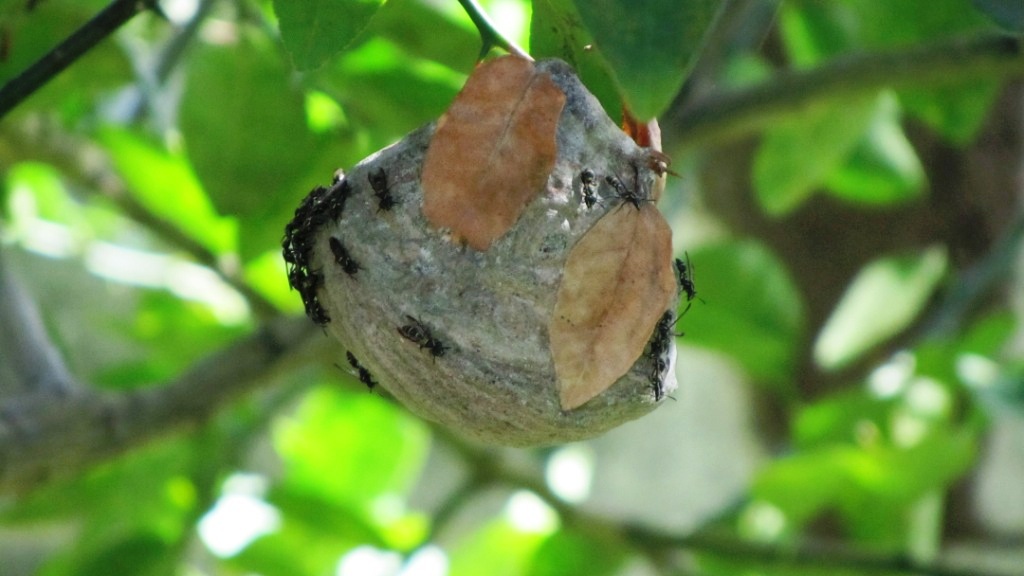
Inside this universe, the culture is ordered, self-contained, compartmentalized, territorialized with a few soldiers walking the perimeter on their watch while newts sleep in their chambers. Workers forage for food, for leaves, for earth – building, sustaining resources. They scour outside their borders entering many lands, every unguarded treasure, a trove for plundered spoils to bring back home to strengthen and protect their empire, their home ground.
As a child, not having such insights, I swashed these jep-nests with long sticks from afar to throw them down, or loped projectiles at them to cut them from their stalks. They clung, built to resist the buffets of interfering cultures.
Not satisfied when they did not fall, I ventured closer with my stick. What joy to see a nation put on alarm! What a spectacular triumph to see everyone come out on the surface, crazed, headless! Refugees all, dangerous yet! Self-preserving in every sense, as they had a right to be, stinging mortally anyone in their path, as they sought safe haven to collect and build again. The survivors flew not far off to regroup at a later time.
Can I learn to co-exist with a different eco-system, a different culture in my front or backyard? Why tip-toe around the Eden I built – be cautious around my orange tree, which I planted for my sustenance, not to share, even those oranges that fall from the tree and that are useless to me, with another group, cultural poacher, in my opinion?
Why live in fear that one day I may forget that replicated me-s exist in my universe, and I may brush my head unawares against the orange (another replicated universal orb) and they will surge to sting me?
Why take the risk?
So far I have resisted ‘licking down’ this porcelain lantern hanging in my orchard.
But who knows? One day I may revert to childhood and stab the nest and run. When I’m sure they’re dead, I’ll come out to poke the ruins and stare in wonder at the last death throes of this magnificent culture that I splattered. After all, it was their fault.
© Cynthia James, September 2013
My visit to Agawa Canyon
“If a tree falls in a forest and no one is around to hear it, does it make a sound?”
I visited Agawa Canyon for the Labour Day weekend. I have no certificate to show I climbed the 300 steps to the top of the lookout. It was an overcast September 1, 2013, and the gloom intensified the white waterfalls, the glassy lakes and animated greens.
Yet I would say fall or winter, or even early spring, would be better times to go. Not that Agawa’s Algoma country is not impressive all clad in green, (what with the decimating California fires as inverse testament***), but I could only imagine how much more breathtaking would have been the autumnal changing of the leaves. Or given my penchant for the starkly atavistic, frost-laden pines and forlorn trees.
The train ride itself is a fire-truck red wonderland, inside and out – red décor, wide windows, a dining cabin, an old century feel. And so, I went straight back in my mind to my first train ride to Flanagin Town (guess where, lol) to visit my school friend, the faithful Phyllis P. Flanagin Town, a weird lonely bush town – What would possess her family to live there? I thought at age 13, leaning out to touch swathes of lastro bordering the meandering train to South.
By contrast the Agawa Canyon train is close-cabined, and as I gazed at the giddying green floating by, in that time bubble two prevailing thoughts crossed my mind.
First, it was as if for me a long-time Christmas had come again with its 1,000 pieces jigsaw puzzle. My brothers, sisters and I bend over a table. Hours and hours pass as we, transfixed, work tenaciously at fitting in a palette of minutely differentiated greens.
A Canadian landscape? Agawa? It could have been, since puzzles, ham, the holly and the ivy, sleigh bells and Christmas trees with angel hair (these I could imagine in every nook and cranny of the Agawa Canyon) came not from where I lived. Nor did Newfoundland salt-fish. Every childhood sip of ginger beer and bite of black cake back then was a deserved reward. Every successful fit of green jigsaw was a triumph, so intricately coloured are these landscape greens.
Second, I heard again that enigmatic question that I had not remembered in a long long while: “If a tree falls in a forest and no one is around to hear it, does it make a sound?” What an epiphany! This time I had an answer. So far from home, in many ways I am and have always been that tree.
***I awoke on September 1, 2013 in Algoma Country to learn that the main building at St. Jacobs Farmers’ Market had burnt to the ground.